
INTRODUCTION:
Neural lace technology is a brain-computer interface that uses a mesh of electrodes to monitor and control brain activity. It’s a part of the field of artificial intelligence (AI). A Neural Lace is a form of BCI technology that involves embedding a flexible, mesh-like interface within the brain. The goal is to create a seamless connection between the brain’s neurons and external devices by using advanced neurotechnology.
The mesh (the lattice) can be injected into the brain, where it forms a scaffold to allow for brain activity monitoring and data transmission. This is done at a microscopic scale, which allows for high-bandwidth communication between the brain and machines.
TECHNOLOGIES USED:
1.Electrodes
- Neuralink’s chip uses thin, flexible threads with 1,024 electrodes to record neuron activity.
- Invasive BCIs use electrodes implanted directly into the brain tissue or on its surface.
- The Emotiv Epoc X is an EEG headset that uses electrodes to record brain activity.
2.Sensors
- Invasive BCIs use sensors implanted directly into the brain’s neural matter.
- Less invasive BCIs use sensors implanted below the scalp or skull.
- A recent research development uses an endovascular sensor threaded through an artery.
3.EEG
- EEG is a common non-invasive technique used to study the brain.
- EEG headsets record brain activity by measuring electrical brain activity.
WORKING:
The functioning of Neural Lace or Brain-Computer Interface technology can be broken down into a few components:
a. Neural Signal Acquisition
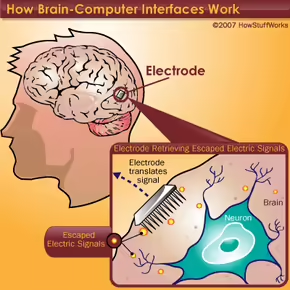
- The brain consists of billions of neurons that transmit electrical signals. A BCI system captures these signals by placing sensitive electrodes on or inside the brain.
- Neural lace specifically uses ultra-thin electrodes or nanotechnology that can be injected into the brain. These electrodes record electrical impulses, detect patterns of activity, and even stimulate neurons.
b. Signal Processing and Interpretation
- The signals received from the brain are then processed by a computer or an external device. This is the most complex part of the technology: interpreting brain signals in a meaningful way.
- Machine learning algorithms are often employed to decode the brain’s activity and translate it into actionable commands or feedback. This could allow for direct control of external devices like a prosthetic limb or computer cursor, or even help to monitor health conditions like epilepsy or Parkinson’s disease.
c. Feedback and Communication
- After processing the brain’s signals, the system may send feedback to the brain. This could involve stimulating neurons or transmitting information back to the brain, like sensory feedback in a prosthetic limb.
- Closed-loop systems are being developed to allow for bidirectional communication between the brain and devices, meaning the system can both receive information from the brain and send feedback to the brain.
ADVANTAGE:
- 1.Treating neurological disorders:
Could potentially help people with paralysis, blindness, epilepsy, and other neurological conditions regain function by bypassing damaged nerves and directly controlling prosthetic devices with their thoughts. - 2.Cognitive enhancement:
May allow for improved memory, learning abilities, and processing speed. - 3.Communication advancements:
Could enable direct communication between individuals through thought alone, bypassing the need for spoken or written language. - 4.Accessibility for people with severe disabilities:
Provides a way for people with severe motor impairments to interact with the world around them through thought control.
DISADVANTAGE:
- 1.Brain damage and infection risk:
Implanting a device directly into the brain could cause significant tissue damage, bleeding, or infection. - 2.Ethical concerns:
Raises questions about privacy, manipulation of thoughts, and the potential for misuse by malicious actors. - 3.Unforeseen long-term effects:
The long-term consequences of having a neural implant in the brain are unknown, including potential side effects on brain function and mental health. - 4.Surgical complexity:
The procedure to implant a neural lace could be highly invasive and require specialized expertise. - 5.Cost and accessibility:
The technology may be expensive and not readily accessible to everyone, raising equity concerns.