
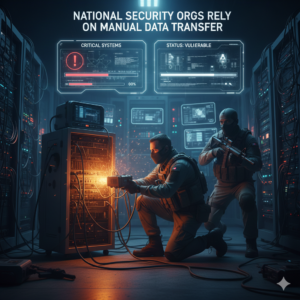
Global / Cybersecurity — A surprising new report reveals that more than half of national security organisations still rely on manual processes to transfer sensitive data — a practice that experts warn can introduce serious security vulnerabilities, inefficiencies and compliance challenges.
Manual Processes Still Widely Used
Despite advances in secure digital infrastructure, a recent CYBER360 report found that many national security entities — including defence agencies and intelligence units — continue to depend on manual transfers of sensitive information rather than automated, integrated systems. This can involve physically moving files, exporting data to removable media, or copying information between disconnected systems by hand.
Why Manual Transfers Persist
There are several reasons organisations fall back on manual data movement:
-
Legacy systems: Older infrastructure often lacks integration or digital interoperability, forcing human intervention to bridge gaps between siloed systems.
-
Security caution: Some agencies distrust automated pipelines for classified data and opt for manual control in the belief it reduces risk.
-
Policy and process inertia: Manual workflows have become entrenched over years, and updating them requires investment, training and cultural change.
Security and Operational Risks
Experts stress that manual data transfers — especially in sensitive environments such as national security — create credible attack vectors and risk exposures for several reasons:
-
Human error: Manual copying or handling increases the likelihood of mistakes — including misplaced files, outdated versions, or mislabelled information — which can compromise operations or reveal sensitive content.
-
Lack of audit trails: Unlike automated systems, manual transfers rarely produce detailed, tamper‑resistant logs, making detection of unauthorized access or data exfiltration more difficult.
-
Security gaps: Workarounds like USB drives and emailed spreadsheets often bypass rigorous security controls, opening opportunities for malware, data leakage, or breaches.
-
Compliance challenges: Manual processes can fail to meet modern regulatory requirements for encryption, data handling and secure transmission, increasing legal and audit risk.
Balancing Automation and Security
While manual methods may offer short‑term control, the cybersecurity consensus increasingly supports secure, automated data transfer frameworks that can enforce encryption, access control and monitoring without human error. Secure file transfer protocols, integrated cross‑domain solutions and governed gateways help maintain both efficiency and confidentiality, especially in classified environments.
The Path Ahead
For national security organisations, moving beyond manual data transfer means investing in interoperable systems that balance operational security with automation, reducing reliance on ad‑hoc workarounds that can weaken defensive postures. As cyber threats evolve, the shift toward secure, automated, and auditable data transfer infrastructures will be central to protecting sensitive national information — and reducing the very vulnerabilities manual processes create.