
Hydrogen fuel cell technology is a clean energy technology that generates electricity by combining hydrogen (H₂) with oxygen (O₂) in a chemical reaction, producing water (H₂O) and heat as byproducts. It’s considered a promising solution for reducing emissions and dependency on fossil fuels, especially in transportation, energy storage, and industrial applications.
COMPONENTS:
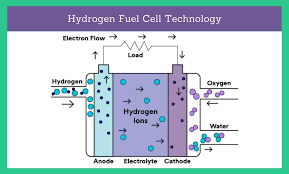
Anode: Where hydrogen gas is introduced. The hydrogen molecules are split into protons (H⁺) and electrons (e⁻)
Electrolyte: The medium that allows protons to pass through from the anode to the cathode, but it blocks the electrons.
Cathode: The place where oxygen is introduced, and electrons travel through an external circuit, generating electricity, before combining with the protons and oxygen to form water.
WORKING:
1.Hydrogen gas (H₂) is supplied to the anode side of the fuel cell.
2.The hydrogen molecules are split into protons (H⁺) and electrons (e⁻).
3.The protons pass through the electrolyte membrane, while the electrons are forced to travel along an external circuit, creating an electric current.
4.Oxygen (O₂) is supplied to the cathode, where it reacts with the electrons coming through the circuit and the protons passing through the electrolyte to form water (H₂O).
ADVANTAGE:
Zero Emissions: The only byproducts are water vapor and heat, making it a very environmentally friendly option.
Efficiency: Hydrogen fuel cells can be more efficient than internal combustion engines and traditional power generation methods.
Energy Independence: Hydrogen can be produced from various sources (renewable, like solar or wind, or non-renewable), offering energy flexibility.
Versatility: Fuel cells can be used for transportation (hydrogen cars), backup power systems, and stationary power generation.
CHALLENGES:
Hydrogen Production: Most hydrogen is currently produced from natural gas, which releases CO₂. The goal is to develop more sustainable, green hydrogen (e.g., produced using renewable energy via water electrolysis).
Storage and Infrastructure: Hydrogen requires high-pressure storage or cryogenic temperatures, which can be complex and costly. Additionally, there is limited refueling infrastructure for hydrogen-powered vehicles.
Cost: Fuel cell technology, particularly the materials needed (like platinum in the catalyst), can be expensive, though costs are gradually coming down with advancements in technology.
APPLICATION:
Transportation: Hydrogen fuel cell vehicles (FCVs), like cars, buses, and trucks, offer a zero-emissions alternative to electric vehicles, especially for long distances.
Power Generation: Fuel cells can provide reliable backup power for homes or businesses and even contribute to grid stability.
Industrial Use: Fuel cells are also used in certain industries where portable power or backup power is needed.