
INTRODUCTION
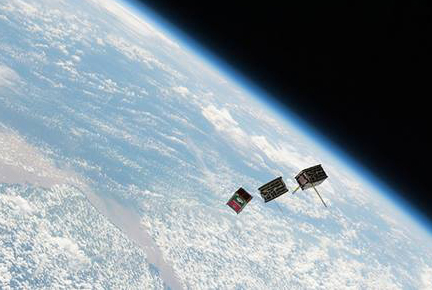
CubeSat swarms refer to a network of multiple small, standardized satellites (CubeSats) working together in coordinated formations.
Unlike single large satellites, these swarms offer advantages in redundancy, flexibility, and cost-effectiveness for various space missions
CUBESAT SWARMS
KEY TECHNOLOGIES
Inter-Satellite Communication (ISC)
- Swarm members communicate via radio frequencies, optical links, or other wireless protocols.
- Ensures coordinated movements and data sharing.
Autonomous Navigation & Control
- Uses AI and machine learning for decentralized decision-making.
- GPS, star trackers, or Earth-based signals guide precise movement.
Formation Flying & Distributed Systems
- CubeSats maintain specific formations for tasks like Earth observation and deep-space exploration.
- Helps in achieving high-resolution imaging or collaborative measurements.
Propulsion Systems
- Miniaturized thrusters (ion, chemical, or electric propulsion) adjust positions.
- Some rely on differential drag for small-scale adjustments.
Power & Energy Management
- Solar panels provide energy, with battery storage for periods of darkness.
- Energy-efficient designs maximize longevity.
Data Collection & Processing
- Sensor payloads vary based on mission goals (e.g., Earth monitoring, space weather tracking).
- Distributed computing helps process and relay information efficiently
APPLICATIONS
Earth Observation & Climate Monitoring
- Continuous global coverage for environmental studies, disaster management, and agricultural monitoring.
Space Weather Monitoring
- Swarms track solar storms, radiation levels, and magnetosphere conditions.
Deep-Space Exploration
- CubeSats work together to explore planets, moons, and asteroids at lower costs.
Communication Networks
- Acts as relay nodes for data transfer in remote areas or deep-space missions.
Defense & Surveillance
- Swarms enhance military intelligence, reconnaissance, and tracking of space debris
PROS AND CONS
✅ PROS
✔ Lower Cost: Small size and mass reduce launch expenses.
✔ Redundancy: If one fails, others in the swarm can compensate.
✔ Scalability: Easy to expand with additional CubeSats.
✔ Rapid Deployment: Faster manufacturing and launching cycles.
❌ CONS
✖ Limited Power & Payload Capacity: Smaller size restricts onboard equipment.
✖ Communication Complexity: Requires sophisticated networking for coordination.
✖ Collision Risks: Managing precise swarm movement is challenging.
✖ Space Debris Concerns: Deorbiting mechanisms are necessary for responsible disposal.
FUTURE OF CUBESAT
With advancements in AI, quantum communication, and miniaturized propulsion, CubeSat swarms will play a crucial role in the next generation of space exploration, defense, and global connectivity.