
Autonomous Underwater Vehicles (AUVs) are unmanned, self-operated robots designed for underwater exploration, data collection, and tasks that would be difficult or dangerous for human divers. AUVs are capable of operating without direct human intervention and can be programmed to perform specific missions autonomously, often for extended periods of time. They are used in a variety of industries such as oceanography, environmental monitoring, defense, oil and gas exploration, and marine biology.
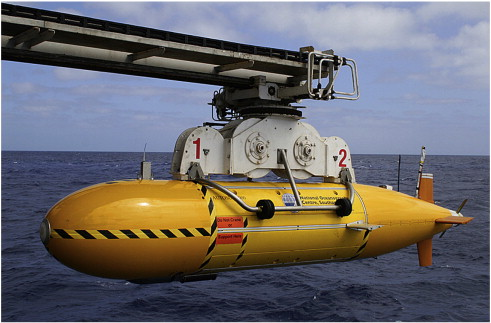
TECHNOLOGIES INVOLVED:
. Sensors and Data Collection
AUVs are equipped with a wide range of sensors to collect valuable environmental and situational data. These sensors allow AUVs to interact with their surroundings and complete a variety of tasks autonomously.
- Sonar Systems:
- Acoustic sonar systems are crucial for underwater navigation and mapping. Side-scan sonar or multibeam sonar are commonly used to capture detailed images of the seafloor and underwater features. These sonar systems provide high-resolution data and allow AUVs to detect objects, identify geological structures, and map the ocean floor.
- Environmental Sensors:
- Temperature sensors, salinity sensors, and pressure sensors are used to monitor oceanographic conditions such as temperature, salinity, and depth.
- Chemical Sensors:
- AUVs can also be equipped with sensors that measure the concentration of various chemical compounds in the water, such as oxygen levels, pH, and nutrient concentrations. This helps in environmental monitoring and oceanographic research.
- Imaging Sensors:
- Cameras and visual sensors help AUVs capture images or videos of marine life, structures, or other objects underwater. Some AUVs also carry laser scanners to create 3D models of underwater environments.
- Magnetic and Acoustic Sensors:
- These are used to detect subsea infrastructure (such as pipelines and cables) or even wreckage and shipwrecks for archaeological or forensic purposes.
2. Navigation and Positioning
AUVs use a combination of technologies to navigate through the ocean, often operating at depths where GPS signals cannot reach.
- Inertial Navigation Systems (INS):
- These systems provide data on the AUV’s orientation and movement (e.g., pitch, roll, and yaw). Accelerometers and gyroscopes are used to track the vehicle’s position and velocity over time, enabling precise navigation.
- DVL (Doppler Velocity Log):
- This technology is commonly used to measure the velocity of an AUV relative to the seafloor by emitting sound waves and measuring the time it takes for the sound waves to return. This provides data on the vehicle’s speed and helps correct any drift in positioning over time.
- Acoustic Positioning:
- AUVs can use acoustic signals to communicate with surface stations or other nearby underwater vehicles. This allows for real-time tracking of the vehicle’s position, especially in deep or remote waters.
3. Propulsion Systems
The propulsion system allows AUVs to move through the water autonomously and control their speed and direction.
- Electric Motors:
- Most AUVs are powered by electric motors that drive propellers or thrusters to propel the vehicle. These motors are usually powered by batteries or fuel cells.
- Battery Power:
- The majority of AUVs use lithium-ion (Li-ion) batteries or lithium-polymer batteries for energy storage. These batteries offer high energy density and are commonly used in AUVs to ensure long operational durations. Battery life can range from a few hours to several days, depending on the mission and AUV size.
- Fuel Cells:
- Some AUVs use fuel cells for longer missions or in cases where additional power is required. These fuel cells use a chemical reaction (usually hydrogen and oxygen) to generate electricity..
4. Autonomous Control Systems
AUVs are designed to work autonomously for extended periods, using onboard control systems to carry out pre-programmed missions without human intervention.
- Mission Planning and Control Software:
- AUVs are typically programmed with a mission plan that dictates how they will navigate, what sensors to activate, and what data to collect. The software ensures that the AUV follows the plan, adjusts to environmental changes, and performs necessary tasks.
- Artificial Intelligence (AI):
- More advanced AUVs incorporate AI algorithms that allow them to learn from their environment and adjust behavior dynamically. This may include adapting to unexpected obstacles or changing environmental conditions (e.g., current strength, temperature).
- Real-time Data Processing:
- AUVs process the data they collect during the mission on board, sometimes filtering, analyzing, and transmitting critical data to operators at the surface. In some cases, AUVs can make decisions based on the data, like changing direction or stopping to collect additional data.
5. Communication Systems
Due to the limitations of traditional communication systems underwater (like radio waves), AUVs rely on specialized communication technologies.
- Acoustic Communication:
- Acoustic modems are the primary means for AUVs to communicate with surface vessels or other underwater vehicles. These systems use sound waves to send and receive data. While acoustic communication can work well over short distances, it can become less effective over long distances or in high-noise environments.
- Through-water Communication:
- More advanced AUVs can use through-water communication systems to transmit data over longer distances without needing a tether or cable. These systems use low-frequency sound waves to send data through water.
- Optical Communication:
- Some systems use light-based communication (such as lasers) for high-bandwidth data transfer when the AUV is close to the surface or other vehicles.
AUV USES:
- Mapping: AUVs can map the ocean floor to detect hazards to navigation.
- Search and rescue: AUVs can be used in search and rescue missions.
- Mine detection: AUVs can be used to detect mines.
- Scientific exploration: AUVs can be used to explore the ocean floor and collect scientific data.
SOME EXAMPLES:
REMUS, Sentry, Mesobot, Orpheus, Slocum Glider, and Spray Glider.
APPLICATIONS:
- Oceanographic Research:
- AUVs are used to explore and study the ocean environment, including seafloor mapping, water quality monitoring, and collecting data on ocean currents, temperature, and salinity.
- Environmental Monitoring:
- AUVs help track the health of marine ecosystems, monitor pollution levels, and collect data on marine biodiversity.
- Oil and Gas Exploration:
- AUVs are used to inspect subsea infrastructure such as pipelines, underwater wells, and oil rigs. They also assist in seabed surveys and geophysical studies for potential drilling sites.
- Search and Rescue:
- AUVs can be used to search for wreckage, perform underwater reconnaissance, or help locate objects lost at sea (e.g., plane wrecks, sunken ships, or submarines).
- Defense and Security:
- In military applications, AUVs are deployed for tasks like mine detection, submarine detection, and intelligence gathering.
- Archaeology:
- AUVs are increasingly being used for underwater archaeology to explore ancient shipwrecks, submerged cities, and historical ruins.
- Marine Biology:
- AUVs can collect data on marine life, observe animal behavior, and monitor underwater habitats for research in marine biology.
ADVANTAGE:
- Cost-Effective:
- Increased Efficiency:
- Access to Hazardous Environments:
- High-Resolution Data Collection:
CHALLENGES:
- Limited Communication:
- Due to the inability of traditional communication systems (like radio) to work effectively underwater, AUVs often rely on slower acoustic systems, limiting real-time interaction with operators.
- Battery Life:
- The limited battery life of AUVs restricts the duration of underwater missions. While advances in energy storage are improving, power remains a key challenge for deep or long-duration operations.
- Navigation Difficulties:
- Accurate navigation in underwater environments is complex, especially in deep waters where GPS signals cannot be used. The reliance on systems like sonar or acoustic positioning can sometimes lead to errors over long distances.
- High Initial Cost:
- The advanced technology and sensors that AUVs require make them expensive to develop, build, and maintain, which can limit their adoption for certain tasks.