
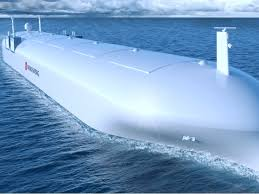
Autonomous ship technology refers to the development and use of vessels that are capable of navigating and operating without the need for human intervention. These ships , often referred to as “unmanned vessels” or “autonomous ships”, use advanced technologies such as sensors, artificial intelligence (AI), machine learning, and automation systems to safely navigate the seas. Autonomous ships are expected to play a significant role in the maritime industry in the near future , potentially improving efficiency, reducing human error, and increasing safety.
TECHNOLOGY USED:
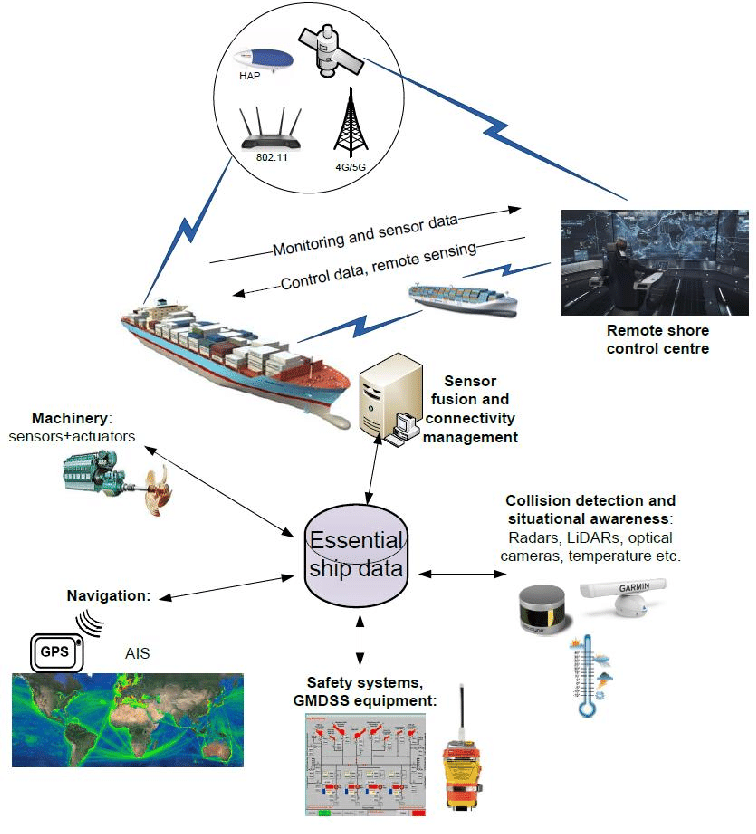
1.Sensors
- Radar: Detects obstacles and other vessels
- LiDAR: Creates 3D maps of the ship’s surroundings
- Sonar: Monitors the ship’s environment
- Cameras: Detect objects and classify them
- Infrared: Provides different outputs that can be combined with other sensors
2.AI and machine learning
- AI: Processes large amounts of data, predicts weather, and avoids obstacles
- Machine learning: Adapts and improves over time, enhancing efficiency and safety
3.Communication systems
- Satellite: Transmits data between the vessel and shore-based control centers
- IoT: Monitors the ship’s environment and machinery
Other technologies
- Integrated automation systems: Allow ships to navigate, make decisions, and perform tasks independently
- GPS data: Used for navigation
- Advanced algorithms: Optimize route planning and collision avoidance strategies
WORKING:
ADVANTAGE:
- Safety: Autonomous ships can reduce human error and increase the safety of life
- Efficiency: Autonomous ships can reduce operating costs, fuel consumption, and crew numbers
- Environmental benefits: Autonomous ships can help reduce emissions and enable the use of alternative fuels
- Space: Autonomous ships can use space more efficiently
DISADVANTAGE:
- Capital costs: The initial investment in autonomous ship technology can be high
- Cybersecurity risks: Hackers could gain control of autonomous ships for illegal activities
- Regulatory uncertainty: The lack of international standards and regulatory frameworks can create uncertainty for companies
- Maintenance: Without a crew, it can be difficult to maintain moving parts on long voyages
- Data management: Autonomous ships generate large amounts of data that must be securely stored and analyzed
- Bandwidth limitations: High-speed communication networks are needed to transmit data between ships and shore-based control centers