
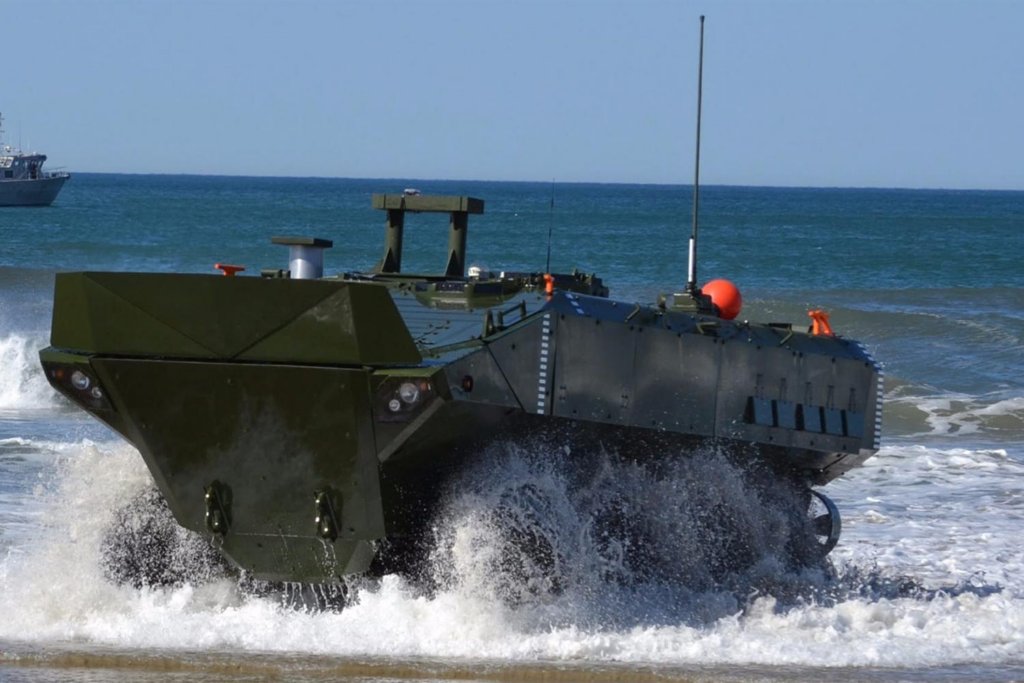
Water-based amphibious warfare vehicles are specialized military machines designed to operate both on land and in water. These vehicles are essential for military operations that require the ability to land forces on shorelines, cross rivers, or move across difficult terrains in coastal and amphibious environments. They are used in a wide range of military operations, including invasions, peacekeeping missions, humanitarian aid, and disaster relief.
“Amphibious warfare vehicles bridge the gap between land and sea operations, providing versatility for armed forces”
TECHNOLOGY USED:
1.Drag reduction:
- Planing hull: A technology that reduces drag
- Retractable walking mechanism: A technology that reduces drag
- Drag reduction accessories: A technology that reduces drag
2.Armor:
- Steel and ceramic armor: A combination that provides protection against bullets
- Run flat tires: Enable vehicles to drive at reduced speeds if a tire deflates
- Blast protection: A design that deflects blast energy
3.Propulsion:
- Wheels or tracks: Some vehicles spin their wheels or tracks to move on or in water
- Screw propellers or water jets: Some vehicles use these to move on or in water
4.Sensors:
- Acoustic, seismic, and magnetic sensors: These can be integrated with seabed nodes
- Acoustic and optical communications: These can support data transfers at high speed
5.Waterproof screens: Allow vehicles to ford deeper waterways
6.Telescopic snorkels: Allow vehicles to ford water that is deeper than the vehicle itself
7.Air-cushioned landing craft (hovercraft): Can replace heavier wheeled and tracked vehicles
HOW IT WORKS:
- Hull Design:The primary feature is a sealed, watertight hull that provides buoyancy and prevents water from entering the vehicle’s interior when submerged.
- Retractable Wheels/Tracks:Most amphibious vehicles have wheels or tracks that can be raised or lowered depending on the terrain. When in water, these are typically retracted to minimize drag and maximize flotation.
- Propulsion System:
- Propellers: Many amphibious vehicles use propellers that rotate underwater to generate forward movement.
- Water Jets: Some designs utilize water jets, which can offer better maneuverability in tight spaces.
- Stability:Amphibious vehicles are designed with a low center of gravity to maintain stability on water and prevent tipping over.
ADVANTAGE:
- Beach access:Can directly land on beaches, enabling troops and equipment to disembark on otherwise inaccessible shorelines.
- Flexibility in operations:Ability to quickly transition between land and water, allowing for diverse mission profiles and adaptability to changing environments.
- Surprise element:Can approach enemy positions from the water, potentially gaining a tactical advantage.
- Shallow water navigation:Some amphibious vehicles are designed to operate in shallow waters, accessing areas inaccessible to larger vessels.
DISADVANTAGE:
- Low water speed:Due to their land-based design, they typically have lower speeds in water compared to dedicated naval vessels.
- Reduced payload capacity:To maintain buoyancy, amphibious vehicles may have a lower carrying capacity when in water compared to land.
- Increased maintenance:Constant exposure to water can accelerate corrosion and wear on components, requiring more frequent maintenance.
- Poor maneuverability:Depending on the design, maneuvering in tight spaces or rough waters can be challenging.
- Vulnerability to waves:Large waves can destabilize amphibious vehicles, impacting their operational effectiveness.