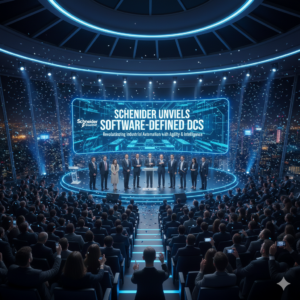
Orlando, Florida / Global — February 10, 2026: Schneider Electric has launched a major innovation in industrial automation with its EcoStruxure™ Foxboro Software Defined Automation (SDA) — the industry’s first open, software‑defined Distributed Control System (DCS) designed to help manufacturers modernise their process control environments more efficiently and flexibly.
A New Era for Industrial Control Systems
Traditional DCS platforms tightly couple specialised hardware with proprietary control software, often making upgrades complex, costly, and slow — especially for ageing plants or hybrid industrial operations. Schneider’s new software‑defined approach decouples the software from the hardware layer, giving organisations the freedom to choose different hardware platforms while maintaining a unified, modern control architecture.
Built on the company’s EcoStruxure Automation Expert framework, Foxboro SDA provides an open, interoperable system that supports modern industrial demands such as IT/OT convergence, real‑time analytics, AI and edge integration, and autonomous operations. The result is greater agility, lower lifecycle costs, and improved scalability without sacrificing the reliability expected of a traditional DCS.
Key Benefits for Customers
-
Open, software‑defined architecture: Decoupling software from hardware enables vendor independence, reducing vendor lock‑in and allowing plants to scale or adapt equipment without major rip‑and‑replace projects.
-
Cybersecure, future‑ready platform: Designed with secure‑by‑design principles and aligned with industrial cybersecurity standards, the system supports safer integration with analytics and automation tools.
-
Lower total cost of ownership: By modernising in phases and avoiding costly hardware refresh cycles, operators can reduce both capital and operational expenses while minimising downtime.
-
Digital continuity: A consistent data model from engineering to maintenance ensures real‑time visibility and smoother workflows across the plant lifecycle.
Strategic Impact
Schneider Electric’s software‑defined DCS represents a shift in how industrial control is delivered — moving away from rigid, proprietary stacks toward flexible, interoperable systems that support digital transformation initiatives such as predictive maintenance, AI‑driven optimisation, and autonomous plant operations. Experts say this architecture could significantly help industries modernise control environments sustainably and at a lower risk.