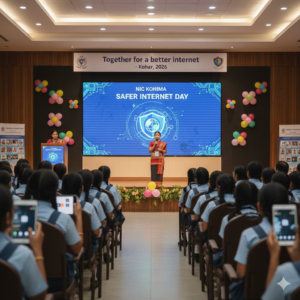
Kohima, Nagaland, India — The National Informatics Centre (NIC), Kohima District Centre, marked Safer Internet Day 2026 with a district‑level awareness campaign aimed at promoting safe, responsible and informed use of the internet and emerging technologies, including artificial intelligence. The event took place at the Conference Hall of the Deputy Commissioner’s Office, Kohima, drawing participants from government, education and the community.
Focus on “Smart Tech, Safe Choices”
Organised under the Information Security Education and Awareness (ISEA) Project led by the Ministry of Electronics and Information Technology (MeitY), the programme adopted this year’s global theme: “Smart Tech, Safe Choices – Exploring Safe and Responsible Use of AI.” This theme reflects growing concern about digital risks such as misinformation, online scams, cyberbullying, deepfakes and privacy violations — particularly as AI becomes increasingly integrated into daily digital life.
In her opening address, EAC Kohima, Imtiyenla K, underscored that while the internet enables communication, access to information, education and entrepreneurial opportunities, it also brings significant risks that require digital literacy and awareness. She highlighted digital illiteracy as a major challenge, especially concerning responsible use of technology and emerging AI tools.
Expert Guidance on Cyber Risks and Safe Practices
The District Informatics Officer (DIO) from NIC Kohima welcomed attendees and outlined how cyber fraudsters exploit human vulnerabilities — including greed and lack of awareness. A detailed presentation by a NIC network field engineer explained key cyber threats such as phishing, UPI/OTP fraud, malware, spyware, social media hacking and deepfake or AI‑generated scams. Participants were urged to verify information, use strong and unique passwords, enable two‑factor authentication and be cautious on public Wi‑Fi networks.
The session also highlighted the positive applications of AI — in healthcare, education, safety and environment monitoring — while cautioning against misuse, bias and privacy concerns. Attendees were advised on fact‑checking AI‑generated content and responsible information sharing online.
Reporting and Support Mechanisms
To empower users further, the programme provided information on reporting suspected cybercrime through the National Cyber Crime Helpline (1930) and the National Cyber Crime Reporting Portal (cybercrime.gov.in), reinforcing the importance of both prevention and action in building a safer digital environment.
Wider Context of Safer Internet Day
Safer Internet Day is observed globally each February to raise awareness about online safety, digital citizenship and responsible technology use, especially among children and young people. In 2026, its focus on the interplay between AI and internet safety reflects broader concerns about emerging digital risks and the need for cyber‑awareness at all levels of society.