
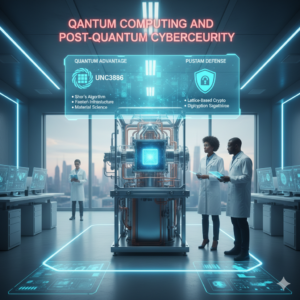
Global / Technology — As quantum computing transitions from theory to practical applications, cybersecurity experts are sounding the alarm: conventional encryption methods may soon be obsolete. The rise of quantum machines capable of solving complex mathematical problems in seconds threatens to break widely used cryptographic standards, prompting the emergence of post-quantum cybersecurity solutions.
Quantum Computing: A Double-Edged Sword
Quantum computers exploit quantum bits (qubits), which unlike classical bits, can exist in multiple states simultaneously. This property allows quantum systems to perform parallel computations on vast datasets, dramatically accelerating problem-solving for tasks such as optimization, drug discovery, and material science.
However, the same capabilities that promise scientific breakthroughs also pose serious cybersecurity risks. Algorithms like RSA, ECC (Elliptic Curve Cryptography), and DH (Diffie-Hellman) — the backbone of secure communications and digital transactions — could be rendered vulnerable to quantum attacks. Experts estimate that quantum computers with thousands of stable qubits could decrypt sensitive data that would take classical computers billions of years to crack.
The Need for Post-Quantum Cryptography
To counter these threats, governments, financial institutions, and tech companies are investing in post-quantum cryptography (PQC). These algorithms are designed to withstand attacks from both classical and quantum computers, ensuring that sensitive data remains secure in the quantum era.
Key developments include:
-
NIST PQC Standardization: The U.S. National Institute of Standards and Technology (NIST) is actively reviewing cryptographic algorithms to determine which are secure against quantum attacks. Standardization is expected to be complete in the coming years, giving organizations guidance on migration strategies.
-
Lattice-Based Cryptography: This approach underpins several promising post-quantum algorithms, leveraging complex mathematical structures that are currently resistant to quantum decryption.
-
Hybrid Encryption Models: Many organizations are implementing hybrid systems that combine classical encryption with quantum-resistant algorithms, ensuring security during the transition period.
Quantum Threats Beyond Cryptography
Quantum computing isn’t just a threat to encryption. It could also impact blockchain systems, digital signatures, and secure communications, all of which rely on cryptographic primitives vulnerable to quantum attacks. This makes preemptive adoption of post-quantum protocols critical for industries handling sensitive data — including banking, healthcare, and government operations.
Industry and Policy Response
Tech leaders are now proactively planning for a “quantum-safe” future:
-
Financial institutions are exploring PQC to protect transaction systems and customer data.
-
Cloud providers are offering quantum-resistant encryption options for enterprise customers.
-
Governments are investing in quantum research while promoting cybersecurity standards to safeguard national infrastructure.
According to experts, the transition to post-quantum cybersecurity is not optional — it’s a necessary strategic move to protect digital trust and critical systems before quantum threats become a reality.
Conclusion
Quantum computing promises a technological revolution, but it also forces a rethink of how digital security is implemented. The next decade will likely see widespread adoption of post-quantum cryptographic standards and hybrid security models, ensuring that organizations can harness quantum power while keeping sensitive information safe.
As quantum machines evolve, post-quantum cybersecurity will move from research labs to boardroom priorities, defining the next era of secure digital infrastructure.