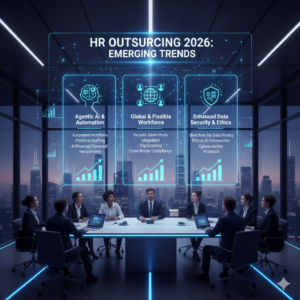
Global — As organisations reimagine how human resources functions are delivered, HR outsourcing (HRO) is evolving from a cost‑saving back‑office solution into a strategic partner for workforce innovation, technology adoption and talent management. In 2026, several powerful trends are redefining what HR outsourcing looks like across industries.
1. From Transactional to Transformational Outsourcing
HR outsourcing is moving beyond administrative tasks (payroll, compliance) to become a strategic enabler of digital transformation and business agility. Companies are partnering with outsourcing firms not just for efficiency, but for expertise in risk management, talent analytics and compliance frameworks. This shift reflects a rethinking of outsourcing as a growth accelerator rather than a cost centre.
2. Deep Integration of AI and Automation
Artificial intelligence (AI) and automation continue to reshape HR services:
-
Outsourcing partners are embedding AI‑driven tools across recruiting, onboarding, payroll and analytics.
-
AI bots now automate high‑volume tasks like resume screening, scheduling, employee queries and workforce data processing.
-
Predictive analytics support smarter decision‑making around hiring, retention and performance management.
By 2026, many providers are expected to offer agentic AI capabilities that can autonomously handle HR workflows — a major leap from basic automation.
3. Data‑Driven Talent Insights & People Analytics
Advanced data analytics is a cornerstone of modern HR outsourcing:
-
Outsourced HR solutions are offering rich workforce insights, forecasting talent gaps and attrition risks.
-
Analytics help firms measure HR’s impact on business outcomes like productivity, retention and engagement.
-
Predictive models support strategic workforce planning and skills development.
Companies now expect outsourcing providers to deliver scalable, analytics‑powered solutions rather than one‑size‑fits‑all services.
4. Skills‑First Hiring and Workforce Flexibility
Traditional job descriptions are giving way to skills‑based sourcing and mobility planning. The shift aligns with broader HR trends prioritising agility and adaptability. Outsourcing partners increasingly support this skills‑first approach, helping clients redeploy or reskill talent as business needs evolve.
5. Customized, Flexible Outsourcing Models
The landscape is moving away from rigid HR packages toward modular, fit‑for‑purpose solutions:
-
Businesses demand tailored service bundles — e.g., recruitment process outsourcing (RPO) combined with compliance support or employee experience tools.
-
Outsourcers are offering scalable engagements based on analytics, sector needs and company maturity, especially for SMEs and high‑growth firms.
6. Technology & Cloud‑First Delivery
Cloud‑based HR platforms are becoming the backbone of outsourced HR delivery, supporting integrated payroll, workforce management and remote workforces. This tech migration enhances accessibility, real‑time reporting and resilience while enabling HR functions to scale with business growth.
7. Compliance, Security & Ethical Risk Management
With global regulatory complexity increasing — particularly around AI use, data privacy and cross‑border employment — outsourcing providers are stepping up compliance, security and risk‑management capabilities. Ensuring data protection and legal adherence is now a core service expectation from clients.
8. Enhanced Employee Experience Through Self‑Service
Outsourced HR isn’t just about back‑office efficiency anymore — it’s also about improving employee experience:
-
Self‑service portals let staff manage payroll, benefits and HR queries independently.
-
AI‑powered chatbots provide 24/7 support, enhancing responsiveness.
-
Personalization features help tailor learning, benefits and career development based on employee preferences.
What This Means for Businesses in 2026
In 2026, HR outsourcing is no longer a commodity service — it’s a strategic lever for competitive advantage. Organisations that partner with progressive HR BPO providers can:
-
Adapt more quickly to talent market shifts and economic uncertainty.
-
Leverage AI responsibly to boost productivity without compromising equity or compliance.
-
Focus internal HR teams on strategic priorities like culture, engagement and leadership development.
-
Scale flexibly, especially amid hybrid work and global talent mobility.
As global workforce demands continue to evolve, outsourcing solutions that embrace technology, analytics, customization and human‑centric design will lead the market in 2026 and beyond.