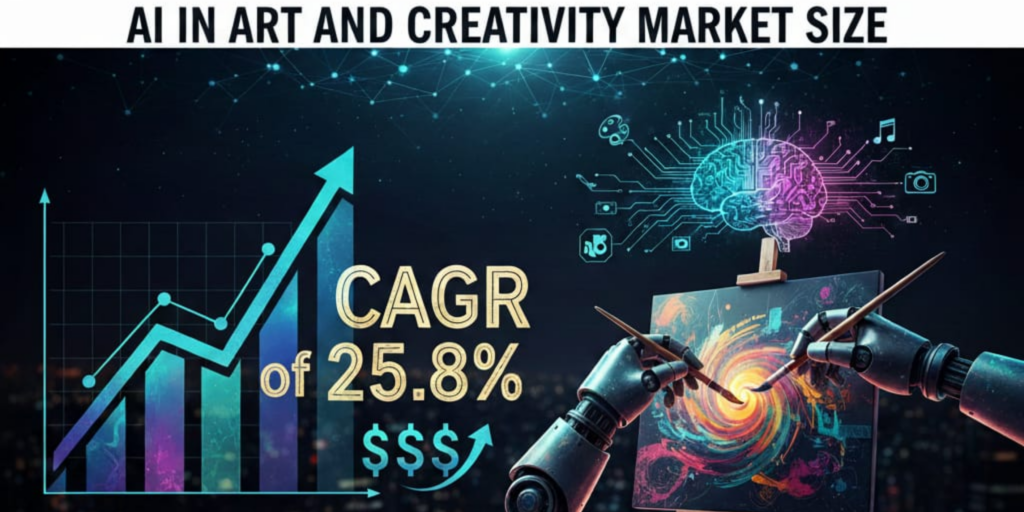
AI in Art and Creativity Market Size | CAGR of 25.8%
By Pentoz Technology, Ooty
The intersection of Artificial Intelligence (AI) and creative expression is no longer a futuristic vision—it’s a fast-growing market reality. Today, AI is transforming how art is created, marketed, and consumed, powering tools that assist with music composition, digital art generation, animation, and even story creation. According to industry forecasts, the AI in Art and Creativity market is projected to grow at a CAGR of 25.8%, signaling rapid global adoption across industries and disciplines.
This explosive growth reflects not only the technological advances in generative AI but also the mainstream embrace of AI-assisted creativity—from individual artists to enterprise-level design studios.
Understanding the AI in Art and Creativity Market
AI is reshaping creative industries by enabling tools that go beyond automation to augment human imagination. These technologies include:
- Generative AI for visual art
Tools like AI image generators allow creators to produce original artwork, concept designs, and visual storytelling elements. - AI in music and audio
Algorithms now assist composers by generating melodies, harmonies, and adaptive soundtracks. - AI-powered animation and motion graphics
Creators use neural networks to streamline character design, motion capture enhancements, and scene generation. - AI-assisted writing and storytelling
Creative writers use language models to ideate, script, and refine narratives.
These tools are not only expanding creative possibilities—they are democratizing access to high-quality creative production.
Market Size & Growth Drivers
The AI in Art and Creativity market is forecast to grow exponentially, with a compound annual growth rate (CAGR) of 25.8% over the next several years. This growth can be attributed to:
1. Widespread Adoption of Generative AI Tools
Advances in generative models (like GANs and transformers) have made AI tools more accessible, affordable, and capable—attracting creators, agencies, and enterprises alike.
2. Demand for Personalized and Dynamic Content
Brands and media companies seek unique, customized content to capture audience attention. AI enables rapid ideation and iteration, driving demand for creative AI solutions.
3. Reduced Time and Cost for Creative Production
AI accelerates workflows that once took weeks or months—making design, concept art, and content creation faster and more cost-effective.
4. Increased Investment in Creative Technology Startups
Investment in AI art platforms and creative tech startups has surged, reflecting confidence in long-term commercial value.
Together, these factors have positioned AI as a core technology in the future of creative industries.
Industry Applications: Where AI Creativity Is Taking Root
Advertising & Marketing
Agencies use AI to produce compelling visuals, write ad copy, and experiment with creative campaigns at scale—without sacrificing quality.
Entertainment & Media
Studios leverage AI for concept art, storyboarding, soundscaping, and even script development—enhancing both productivity and innovation.
Gaming
AI assists in generating realistic environments, procedural content, character design, and interactive storytelling that adapts to player behavior.
Education & Art-Tech Platforms
AI tools are empowering students and educators to experiment creatively, removing barriers to entry in artistic practice.
Challenges and Ethical Considerations
While growth is strong, the market also faces challenges:
- Copyright and attribution issues
- Ethical use of AI-generated content
- Balancing AI assistance with artistic authenticity
- Ensuring equitable access to creative AI tools
These concerns are prompting industry standards, guidelines, and ethical frameworks that will shape the next phase of growth.
What This Means for Learners and Innovators
For students, artists, and technologists, the AI in Art and Creativity market offers exciting opportunities to combine technical skill with artistic expression. Learning AI tools can open pathways in:
- Digital and generative arts
- Creative technology development
- UX/UI and interactive media
- AI-enhanced storytelling and multimedia creation
At Pentoz Technology, Ooty, we support learners and professionals in building future-ready skills that bridge AI technology and creativity.
Conclusion
The projected CAGR of 25.8% for the AI in Art and Creativity market reflects not just rapid technology adoption—it marks a fundamental shift in how creativity is conceived and executed across industries.
AI is no longer just a tool—it’s a creative partner, expanding what’s possible in art, storytelling, design, and digital expression.
To stay ahead in this evolving landscape, embrace both creative thinking and AI proficiency—because the future of art is intelligent, collaborative, and powered by innovation.
NEWS ARTICLE
AI in Art and Creativity Market Size | CAGR of 25.8%
The global market for artificial intelligence in art and creativity is experiencing rapid growth, with industry analysts projecting a compound annual growth rate (CAGR) of 25.8% over the coming years. This surge reflects the expanding use of AI tools in creative fields such as visual arts, music, film, design, advertising, and digital content creation.
AI-powered creative platforms are enabling artists and designers to generate images, videos, music, and written content faster and more efficiently than ever before. Technologies such as generative adversarial networks (GANs), diffusion models, and large language models are reshaping how creative work is produced, lowering barriers to entry while opening new possibilities for experimentation and personalization.
The market’s growth is being driven by increasing adoption across commercial sectors. Advertising agencies, media companies, and entertainment studios are using AI to speed up production cycles, customize content for different audiences, and reduce costs. In gaming and animation, AI assists in character design, environment creation, and storytelling, allowing creators to focus more on conceptual and artistic direction.
Small businesses and independent creators are also contributing to market expansion. Subscription-based AI tools and cloud platforms have made advanced creative technology accessible without significant upfront investment. This democratization of creativity is fueling demand across emerging markets and expanding the global user base.
However, the rapid rise of AI in art has raised concerns around originality, copyright, and ethical use. Artists and policymakers are debating ownership of AI-generated works and the use of copyrighted material in training datasets. These issues are prompting calls for clearer regulations and industry standards as the market continues to grow.
Despite these challenges, analysts remain optimistic. Ongoing advancements in AI models, improved human–AI collaboration tools, and growing acceptance of AI-assisted creativity are expected to sustain strong market momentum. As AI becomes an integral part of the creative process, the sector is poised for long-term expansion.
With a projected CAGR of 25.8%, the AI in art and creativity market is set to become a significant force in the global creative economy, redefining how art is created, distributed, and experienced in the digital age.