
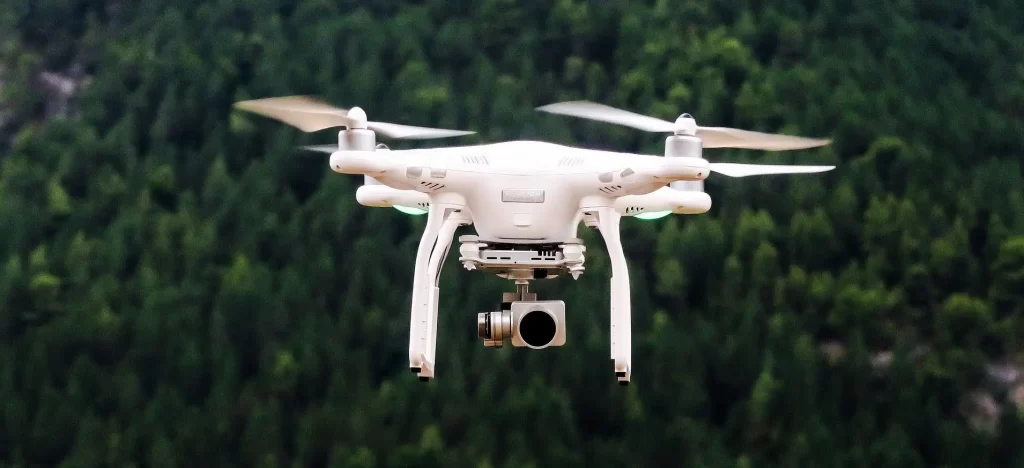
Unmanned aerial vehicle (UAV), military aircraft that is guided autonomously, by remote control, or both and that carries sensors, target designators, offensive ordnance, or electronic transmitters designed to interfere with or destroy enemy targets. Unencumbered by crew, life-support systems, and the design-safety requirements of manned aircraft, UAVs can be remarkably efficient, offering substantially greater range and endurance than equivalent manned systems
WORKINGS OF UAV:
An unmanned aerial vehicle (UAV), commonly called a drone, operates by utilizing a combination of onboard sensors, a flight control system, and a communication link to a ground control station, allowing it to fly autonomously or be remotely piloted, capturing data and performing tasks without a human operator on board; essentially, it uses aerodynamic forces to stay airborne, receiving commands from a ground station to navigate and execute missions based on pre-programmed flight plans or real-time operator inputs depending on the level of autonomy.
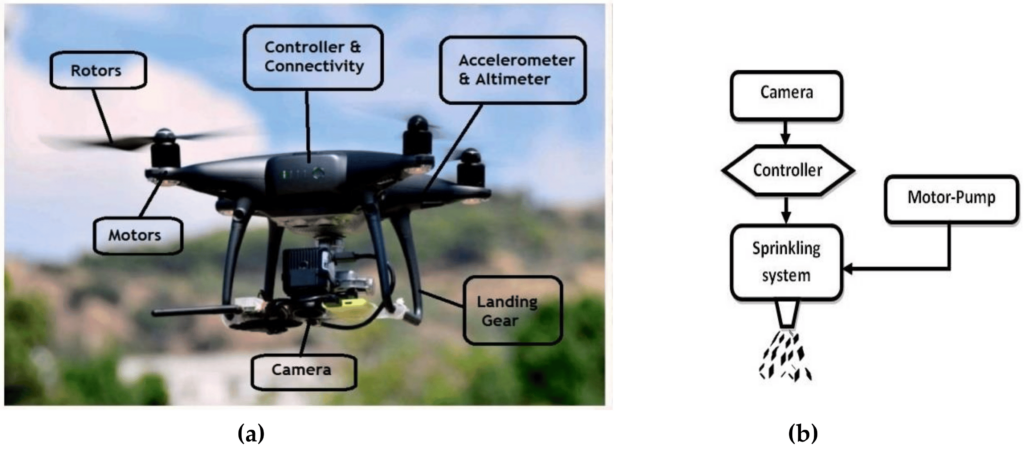
- Airframe : The physical body of the drone, including the wings, fuselage, and propellers (for rotary-wing drones) or rotors (for fixed-wing drones) which generate lift to stay airborne.
- Flight control system : An onboard computer that manages the drone’s stability, orientation, and movement by adjusting motor speeds based on sensor inputs like gyroscopes, accelerometers, and GPS.
- Payloads : The sensors or equipment carried by the drone, such as cameras, thermal imaging devices, LiDAR scanners, or even small payloads for delivery depending on the mission.
- Ground control station (GCS) : A computer interface on the ground where the operator sends commands to the drone, receives real-time data from its sensors, and monitors its flight path.
- Communication link : A radio frequency or satellite connection that transmits control signals to the drone and relays data from the drone back to the GCS.
Types of UAVs:
- Fixed-wing : Resembles a traditional airplane with fixed wings, generally used for longer flight durations and larger coverage areas.
- Rotary-wing (multirotor) : Has multiple rotors for hovering and maneuverability, ideal for close-up inspections and tight spaces.
- Blimp : A lighter-than-air craft with good endurance, suitable for surveillance and monitoring applications.
DISADVANTAGES OF UAV:
- Accidents: Drones can crash due to technical failures like battery or motor problems, or adverse weather like strong winds or rain
- Unauthorized use: Drones can be used without authorization, which can be dangerous
- Intrusive surveillance: Drones can be used to invade people’s privacy
- Security breaches: Drones can be vulnerable to attacks, which can lead to security breaches
- Restrictions: Drones may not be allowed to fly in certain areas or at certain times
- Job displacement: Drones may replace human workers in some industries
Applications of UAVs:
- Aerial photography and videography : Capturing images and videos from above for various purposes including real estate, surveying, and filmmaking.
- Agriculture : Monitoring crop health, identifying disease outbreaks, and optimizing irrigation
- Inspection and maintenance : Inspecting infrastructure like power lines, pipelines, and bridges
- Search and rescue : Locating missing persons in difficult terrain
- Military applications : Reconnaissance, surveillance, target acquisition, and delivery of munitions
REFERENCE LINK: