
Asteroid mining involves extracting valuable materials from asteroids, offering potential solutions to Earth’s resource challenges and enabling future space exploration.
Asteroid mining is the process of extracting raw materials from asteroids and other minor planets. The extracted materials can be used to make military equipment, spacecraft fuel, and more.
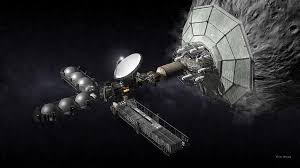
Asteroids:
- Asteroids contain precious metals like platinum, gold, silver, cobalt, and iron
- They also contain more common elements like nickel and magnesium
- Asteroids are the remains of proto-planets, or failed planetesimals
IMPORTANCE OF ASTEROIDS MINING:
- Asteroid mining could help solve Earth’s resource depletion and carbon pollution problems
- It could provide an alternative source of materials when global conflicts or scarcity make it difficult to get materials from Earth
TECHNOLOGIES USED:
Robotic Spacecraft: Autonomous robots are designed to land on asteroids, extract materials, and return them to Earth. For instance, NASA’s OSIRIS-REx mission successfully collected samples from asteroid Bennu, providing insights into asteroid composition and mining feasibility.
In-Situ Resource Utilization (ISRU): This approach focuses on processing materials found on asteroids to produce fuel, water, and other necessities, reducing the need to transport resources from Earth. Technologies like 3D printing and advanced robotics are integral to ISRU.
Mining and Extraction Techniques: Innovations such as laser ablation, ion beam processing, and microwave heating are being explored to extract materials from asteroids. These methods aim to efficiently break down asteroid materials for processing.
HOW IT WORKS:
1.Identification and Target Selection:
- Asteroid Surveying: Astronomers and space agencies use telescopes and space-based observatories to identify near-Earth objects (NEOs) that are rich in valuable materials such as metals and water.
2. Mission Planning and Design:
- Spacecraft Development: Designing specialized spacecraft capable of traveling to, landing on, and operating in the microgravity environment of an asteroid is crucial.
3. Launch and Transit:
- Spacecraft Launch: Once developed, the spacecraft is launched from Earth using powerful rockets. The journey to the target asteroid can take several years, depending on the asteroid’s location and the spacecraft’s propulsion capabilities.
4. Arrival and Operations:
- Asteroid Rendezvous: Upon reaching the asteroid, the spacecraft performs a rendezvous, matching its orbit with that of the asteroid. This phase involves precise navigation to ensure a stable approach and positioning.
- Surface Operations: The spacecraft deploys mining equipment, such as drills or robotic arms, to extract materials from the asteroid’s surface.
5. Material Processing and Return:
- Processing: Extracted materials are processed on-site to separate valuable resources from waste. This may involve refining metals or converting water into hydrogen and oxygen for fuel.
- Return to Earth: Processed materials are stored and prepared for return to Earth. The spacecraft then initiates its return journey, re-entering Earth’s atmosphere and delivering the materials for further analysis and utilization.
CHALLENGES OF AM:
- Distance and travel time:Reaching asteroids can take a long time, requiring advanced propulsion systems.
- Low gravity:Operating machinery and manipulating materials in near-zero gravity presents significant engineering challenges.
- Asteroid composition variability:Different asteroids have varying mineral compositions, requiring customized extraction techniques.
- Cost of development:Designing and building the necessary spacecraft and mining equipment is extremely expensive.
POTENTIAL BENEFITS:
- Access to rare materials:Asteroid mining could provide a source of precious metals and other valuable resources that are scarce on Earth.
- Space exploration advancement:Developing technologies for asteroid mining could drive innovation in space travel and habitation.
- Resource sustainability: Mining asteroids could potentially alleviate Earth’s reliance on limited terrestrial resources.