
Quantum cryptography leverages the principles of quantum mechanics to enhance data security, offering a level of protection that classical cryptographic methods cannot achieve. The most prominent application of quantum cryptography is Quantum Key Distribution (QKD), which enables two parties to generate a shared, secret key with the assurance that any eavesdropping attempt will be detected.

T
TECHONOLOGY USED:
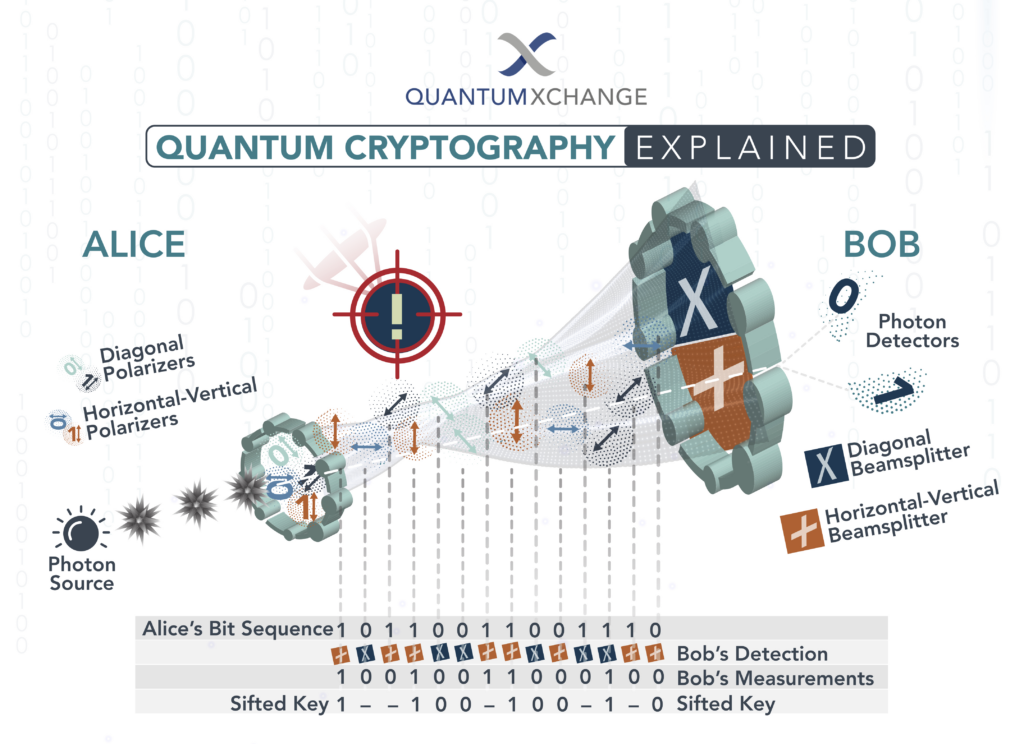
- Quantum key distribution (QKD): A method that uses photons to transmit a random key between two parties. QKD can detect eavesdropping by comparing measurements taken at each end of the transmission.
- One-time pad: A technique that uses cryptographic keys produced in advance by QKD.
- Software-controlled optical switches: Used to steer photons down the correct optical fiber.
- Quantum-resistant algorithms: Used to protect transmissions from future quantum computers.
WORKING:
- A random sequence of photons is created.
- The photons are transmitted over fiber optic cables.
- Both parties examine some of the photons to see if they’ve been tampered with.
- If the photons are tampered with, the key is discarded.
- If the photons are not tampered with, the key is used to secure data.
ADVANTAGES:
Unconditional Security: Quantum cryptography provides security based on the fundamental laws of physics, making it virtually unhackable. Any attempt to intercept or measure the quantum data alters its state, alerting the communicating parties to potential eavesdropping.
Tamper Detection: It allows for the detection of eavesdropping in Quantum Key Distribution (QKD). If an unauthorized party tries to intercept the quantum key, the disturbance caused by the measurement will be noticeable, ensuring the integrity of the communication.
Enhanced Privacy: Quantum cryptography offers elevated privacy standards through advanced encryption and cryptographic techniques. It creates safe ways to send messages that are very hard for others to spy on or hack into, enhancing privacy and data security in digital communication networks.
DISADVANTAGES:
High Cost: Implementing quantum cryptography can be expensive due to the need for specialized hardware and expertise. The technology requires advanced equipment and infrastructure, which can be a significant investment for organizations.
Limited Availability: Quantum cryptography is not widely available, as it requires specialized hardware and software. The technology is still in the developmental stage, and its practical, large-scale implementation faces challenges such as the need for specialized hardware and the effects of quantum noise.
Complex Implementation: Implementing quantum cryptography can be complex, as it requires specialized expertise and knowledge of quantum mechanics. The intricacies of quantum mechanics make it challenging to develop and maintain quantum cryptographic systems.