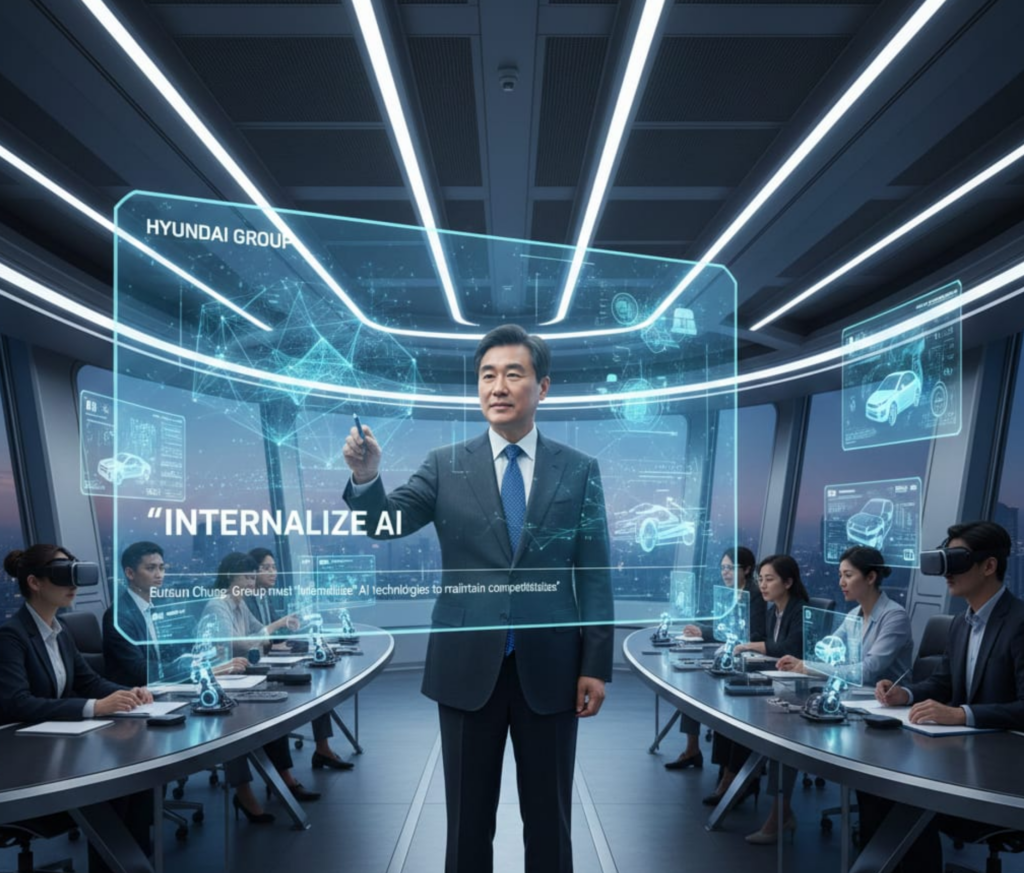
Hyundai’s Euisun Chung Says Group Must ‘Internalize’ AI Technologies to Maintain Competitiveness
By Pentoz Technology, Ooty
In today’s fast-evolving technological landscape, Artificial Intelligence (AI) has become a critical force shaping the future of global industries — and one of the clearest voices in this conversation is Euisun Chung, Executive Chairman of Hyundai Motor Group. According to Chung, Hyundai must “internalize AI technologies” to stay competitive amid rapid digital transformation.
This emphasis on AI isn’t just strategic — it’s essential. For technology companies, automotive manufacturers, and future professionals alike, understanding this shift reveals how AI is powering the next generation of innovation.
Why Hyundai Is Focusing on AI
Hyundai’s call to internalize AI reflects a broader recognition:
Traditional industries can no longer rely on legacy processes alone — they must integrate AI deeply into their DNA.
Chung’s message is clear. To sustain growth and leadership:
- Hyundai must embed AI across its engineering, design, and manufacturing processes
- The company must accelerate AI adoption in software development, data analysis, and customer personalization
- AI must become a core competency, not an add-on tool
In other words, Hyundai views AI as a core pillar of future competitiveness, not just a trend.
What “Internalizing AI” Really Means
When Chung talks about “internalizing” AI, he’s referring to more than adopting off-the-shelf technology. He means:
1. Building AI Capabilities In-House
Rather than outsourcing or depending solely on partners, companies must grow their internal expertise — from data scientists to AI engineers and research teams.
2. Integrating AI Into Product Development
AI needs to be woven into every stage:
- Vehicle design and simulation
- Autonomous driving systems
- Predictive maintenance and safety
- Connected car experiences
This integration turns data into actionable insights and real value.
3. Making AI Part of the Company Culture
AI literacy should become a company-wide strength, not limited to specialized teams. Future innovations will depend on cross-functional collaboration between engineers, designers, product managers, and AI specialists.
How This Shift Impacts the Automotive Industry
Hyundai’s AI focus signals a wider transformation in the auto sector:
🔹 AI for Next-Gen Mobility
AI will power:
- Advanced driver assistance systems (ADAS)
- Autonomous driving capabilities
- Real-time environmental perception
- Intelligent traffic prediction
Vehicles of tomorrow will be defined by how intelligently they can sense, learn and act in real time.
🔹 AI in Manufacturing and Quality Control
From robotics to automated inspection, AI helps manufacturers:
- Improve production efficiency
- Reduce defects
- Enhance overall quality
- Maximize cost effectiveness
This creates smarter factories and more reliable products.
🔹 Enhanced Customer Experiences
AI enables personalized interfaces, predictive service schedules, and tailored driving experiences — making customers feel understood and valued.
The Broader Message for Tech Learners and Businesses
Hyundai’s push to internalize AI is a reminder for all industries:
AI isn’t optional — it’s a strategic competitive advantage.
For businesses, the message is clear:
- Embed AI into core operations
- Cultivate AI talent
- Invest in long-term AI research and innovation
For students and professionals, this presents an opportunity:
✨ AI skills are becoming fundamental — whether in engineering, product design, analytics, or leadership.
At Pentoz Technology, Ooty, we champion learning that aligns with real-world industry trends. AI, data science, automation, and machine learning are no longer futuristic subjects — they are the skills of today and tomorrow.
Conclusion
Hyundai’s Euisun Chung isn’t just talking about adopting technology — he’s highlighting a mindset shift.
To remain competitive in a world driven by data and intelligence, companies must internalize AI at every level — from engineering to customer engagement.
This approach isn’t exclusive to the automotive sector. It’s a lesson for every industry navigating digital disruption.
AI isn’t just the future — it’s the foundation of the present.
And those who internalize it early will shape the next era of innovation.