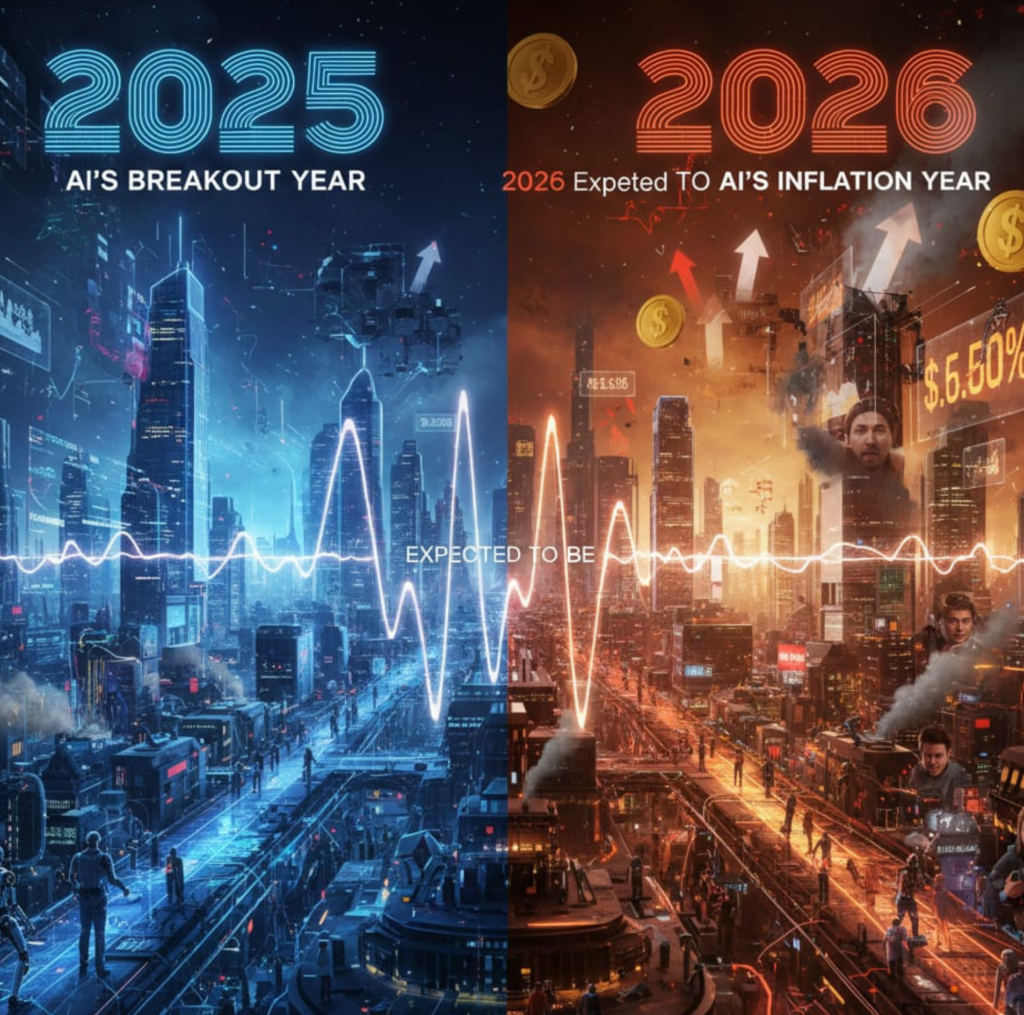
2025: AI’s Breakout Year — 2026 Expected to Be AI’s Inflation Year
By Pentoz Technology, Ooty
The year 2025 will be remembered as the moment Artificial Intelligence truly broke into the mainstream. What was once considered experimental or futuristic rapidly became practical, profitable, and deeply embedded in everyday life. From classrooms and offices to hospitals and creative industries, AI moved beyond hype and into real-world impact.
As we step toward 2026, experts predict something even bigger: AI’s inflation year—a phase where AI adoption, investment, expectations, and influence expand at an unprecedented scale.
2025: The Year AI Went Mainstream
In 2025, AI stopped being a “nice-to-have” technology and became a business and productivity necessity.
Key breakthroughs included:
- Generative AI becoming a standard workplace tool
- AI copilots integrated into software development, design, and analytics
- Rapid adoption of AI in education, healthcare, finance, and manufacturing
- Startups and enterprises restructuring workflows around AI automation
For students and professionals alike, AI skills became career-defining, not optional. Companies that delayed adoption quickly felt competitive pressure.
At Pentoz Technology, Ooty, this shift was evident as learners increasingly focused on AI-powered development, automation, and data-driven decision-making.
Why 2026 Is Expected to Be AI’s Inflation Year
If 2025 was about acceptance, 2026 will be about acceleration.
“AI inflation” does not mean economic inflation—it refers to the explosive growth in AI usage, valuation, expectations, and dependency across sectors.
Here’s why 2026 will mark that turning point:
1. AI Everywhere, Not Just in Tech
By 2026, AI will no longer be confined to IT companies.
Education, agriculture, logistics, retail, government services, and small businesses will adopt AI at scale.
AI will quietly power:
- Decision-making systems
- Personalized services
- Predictive analytics
- Customer interactions
The result? AI becomes invisible but indispensable.
2. Rising Investment and Valuations
As AI proves its ROI, funding and corporate spending will surge. Companies will invest heavily in:
- AI infrastructure
- Custom AI models
- Skilled AI professionals
This rapid capital inflow is what many analysts call AI inflation—where demand, cost, and expectations all rise together.
3. AI Skills Will Command Premium Value
In 2026, AI-literate professionals will see increased demand and compensation. Roles combining AI + domain knowledge (AI + healthcare, AI + finance, AI + education) will dominate job markets.
Those without AI skills may struggle to stay relevant, while those trained early will benefit from the inflationary demand.
This makes AI education and upskilling more critical than ever.
4. Increased Regulation and Responsibility
With greater influence comes greater scrutiny. Governments worldwide will introduce stronger AI governance, ethical standards, and compliance requirements.
In 2026:
- Responsible AI will become a legal and moral priority
- Transparency and bias control will matter
- Companies will be held accountable for AI misuse
This phase will separate serious AI builders from hype-driven adopters.
5. The Risk of Overexpectation
History teaches us that inflationary phases often bring overconfidence and unrealistic expectations. Not every AI product will succeed, and some valuations may correct.
However, just like the internet after the dot-com era, AI will emerge stronger, more focused, and deeply embedded in society.
What This Means for Students and Businesses
For learners, 2026 is the time to:
- Build strong AI fundamentals
- Learn practical, application-oriented skills
- Combine AI with real-world problem solving
For organizations, it’s about:
- Smart adoption, not blind adoption
- Investing in talent and ethics
- Preparing for long-term transformation
At Pentoz Technology, Ooty, we believe the key to surviving AI’s inflation year is knowledge, adaptability, and responsible innovation.
Conclusion
2025 marked AI’s breakout.
2026 will define AI’s true economic and societal weight.
Those who prepare now will ride the wave. Those who ignore it may find the gap impossible to close later.
AI is no longer the future—it is the present, accelerating fast.
NEWS ARTICLE
2025, AI’s Breakout Year: 2026 Expected To Be AI’s Inflation Year
The year 2025 marked a decisive turning point for artificial intelligence, as AI technologies moved from experimental tools to essential infrastructure across industries. From enterprise software and healthcare to finance and manufacturing, AI adoption accelerated at an unprecedented pace. Now, experts warn that 2026 could bring a new challenge: AI-driven inflation.
In 2025, companies worldwide invested heavily in AI models, data centers, specialized chips, and cloud infrastructure. Demand for high-performance GPUs, advanced semiconductors, and energy-intensive computing surged, pushing up costs across the technology supply chain. This rapid expansion positioned AI as a backbone of the global digital economy—but also laid the groundwork for inflationary pressure.
Analysts predict that in 2026, AI-related costs could ripple through broader markets. As businesses pass on rising expenses for cloud services, AI subscriptions, and automation tools, prices for goods and services may increase. Sectors that rely heavily on AI infrastructure, such as financial services, logistics, and e-commerce, are expected to feel the impact first.
Another factor driving potential inflation is the growing competition for AI talent. In 2025, demand for skilled AI engineers, data scientists, and chip designers far outpaced supply. Rising salaries and recruitment costs are likely to continue into 2026, adding further pressure to operating expenses for tech firms and AI-dependent businesses.
Energy consumption is also emerging as a concern. Large-scale AI models require enormous computational power, increasing electricity demand and straining existing energy systems. In regions where energy costs are already high, AI data centers could contribute to higher power prices, indirectly affecting consumers and industries alike.
However, experts caution that AI-driven inflation may be uneven and temporary. Over time, productivity gains from automation, smarter logistics, and improved decision-making could offset higher costs. As AI systems become more efficient and hardware innovation advances, the cost per computation is expected to decline, easing inflationary pressure.
Policymakers and central banks are closely monitoring these developments. Some economists argue that AI could ultimately be deflationary by boosting productivity, while others warn of short-term price shocks as economies adjust to rapid technological change.
As 2026 approaches, the focus is shifting from AI’s breakthrough potential to its macroeconomic impact. Whether AI becomes a sustained inflationary force or a long-term productivity driver will depend on how quickly industries adapt, regulations evolve, and efficiency catches up with innovation.